
Pass boxes in Classified Areas

Pass boxes in Classified Areas

Know the types of pass boxes used in pharmaceutical classified areas to transfer the material in different grade areas.
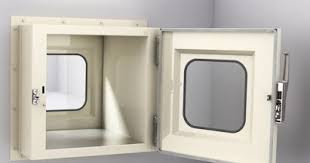
Pass box is used to transfer the material from lower cleanliness area to higher cleanliness area or vice-versa in the classified area and also known as the batch. Pass box works as a barrier between two cleanliness level areas.

Pass boxes are used to transfer material for blending, granulation or sterilization in the manufacturing area and sterilization & incubation in the microbiology laboratory. In some cases, equipment parts are also transferred through the pass boxes in sterile manufacturing areas.

Pass boxes help to prevent the air flow from one area to another while transferring the material. One door of the pass box opens at a time and both the doors cannot be opened simultaneously. There should be an interlocking system in the pass boxes.

Pass boxes are of two types - A) Dynamic Pass box B) Static Pass box

a) Dynamic Pass box:

Dynamic pass box works like an airlock or Laminar Air Flow unit. Clean air enters in the pass box and prevents the entrance of the contamination. Dynamic pass boxes may be Cascade, Sink or Bubble type similar to the a irlocks in pharmaceuticals.

b) Static Pass box:

Static pass boxes are simple boxes mounted between two areas and also known as passive pass boxes. The area having higher cleanliness level shall have the higher pressure that helps to prevent the entrance of contamination in the sterile area. 

Ultra-violet light is also installed in the pass boxes to remove the contamination that may enter during the transfer of material. It should be replaced after 1000 burning hours. Pass boxes should be cleaned with disinfectants at regular intervals. The efficiency of the pass boxes should be verified by validation. Validation may be done by exposing the known population of the bacterial culture.

Comments

Popular posts from this blog

Checklist for Audit in Sterile Area

Checklist for Audit in Sterile Area Checklist to verify the sterile manufacturing area before the audit. 1. Is there any SOP giving details for activity/ movement in the sterile area. 2. Verify the suitability of system for sanitization of hands. 3. Is there the SOP on entry-exit; gowning and de-gowning into the critical area available? 4. Verify the availability of following records:  Air pressure differential  Particulate monitoring  Temperature  Humidity  Microbiological monitoring by settle plate 5. Are these records available and maintained as per SOPs? 6. Check the above mentioned individual records. Are the entries within specifications mentioned in SOP/ MTPs. 7. Is the controlled copy of MTP pertaining to monitoring by settle plate available to plant person? 8. Are the location for settle plates identified and the chart/ layout available with plant? 9. Are the following areas monitored for parameters mentioned in step 4:  Air-lock to the critical ar...

Aseptic Filling Process (Media Fill) Validation Protocol in Sterile Pharmaceuticals

Aseptic Filling Process (Media Fill) Validation Protocol in Sterile Pharmaceuticals Validation of sterile manufacturing process by media fill validation test as per PICS guidelines for aseptic validation or aseptic process simulation. 1.0 OBJECTIVE 1.1 To define procedures for validating and maintaining the validation of all aseptic filling processes and qualification of the quality of the product by system/facility/equipment. 2.0 SCOPE 2.1 This procedure applies to all aseptically filled sterile products intended for human use. 3.0 RESPONSIBILITY 3.1 The Validation personnel coordinate the aseptic filling validation program and write the sterile media aseptic filling processes reports. 3.2 Manufacturing personnel the sterile media aseptic filling processes and performs the sterile media fills. 3.3 QA personnel perform the sampling and assist with the IPQA monitoring required for each sterile media fill. 3.4 QC personnel to perform the testing and assist with the monitoring required fo...

Blow Fill Seal (BFS) and Form Fill Seal (FFS) Technology in Sterile Manufacturing

Blow Fill Seal (BFS) and Form Fill Seal (FFS) Technology in Sterile Manufacturing Know about sterile pharmaceutical production using Blow Fill Seal (BFS) and Form Fill Seal (FFS) technology. Both of these techniques are used to manufacture  sterile pharmaceutical products   as parenteral (LVP & SVP), infusions, ophthalmic and inhalation products. These are automated techniques to prepare sterile products. The basic concept of the  FFS   and BFS is to reduce the  contamination   by forming the container, filling and sealing in a closed sterile chamber of the machine. There is no personnel intervention to reduce the chances of the contamination during the manufacturing of sterile products. It gives more production at very low operational cost with the high assurance of  sterility . Blow fill seal technology is widely used and accepted by the various pharmaceutical regulatory authorities as US-FDA and MHRA. The system is being used for over 30 years a...

MSDS (Material Safety Data Sheet)

MSDS   What Is an MSDS? An MSDS (Material Safety Data Sheet) is a document that provides detailed information about a chemical substance, including its hazards, safe handling procedures, storage requirements, and emergency measures. Today, MSDS is more commonly called SDS (Safety Data Sheet) under the Globally Harmonized System (GHS). Why MSDS / SDS Is Important Protect workers and employees Ensure safe handling and storage of chemicals Prevent accidents and injuries Provide emergency response information Comply with workplace safety regulations.  MSDS (Material Safety Data Sheet)  International safety standards.  GHS – Globally Harmonized System Full form: Globally Harmonized System of Classification and Labelling of Chemicals Develop by United Nations (UN).  OSHA (USA) – Hazard Communication Standard (HCS) Factories Act & Chemical Rules (India) Factories Act, 1948 Manufacture, Storage and Import of Hazardous Chemical Rules, 1989 REACH (Europe) REACH Regula...

Sterility Testing by Direct Inoculation Method

Sterility Testing by Direct Inoculation Method Direct Inoculation Method Learn the procedure for sterility test for sterile pharmaceutical products by direct inoculation method. 1.0 Objective :  To lay down Standard Operating Procedure is to provide guidelines for sterility testing by Direct Inoculation Method. 2.0 Scope This procedure is applicable for the products manufactured at the location which can not be tested by Membrane Filtration Method. 3.0 Responsibility Implementation: Microbiologist 4.0 Accountability Execution: Manager - QC Review & Approval : AGM - QA / QC Procedure Direct Inoculation Method Sample for Finished Products: Collect the samples to be tested for sterility. Out of the whole sample, randomly select 20 articles of each lot of batch for both LVP and SVP t erminal ly sterilized products and for aseptically filled products.    Sample for Intermediates: Randomly collect 16 pre-sterilized bottle samples to be tested for sterility from LVP bot...