
Restricted Access Barrier System (RABS) in Pharmaceuticals

Restricted Access Barrier System (RABS) in Pharmaceuticals

Restricted Access Barrier Systems are very useful in sterile pharmaceutical manufacturing to maintain the sterility of the products.

Restricted Access Barrier System
(RABS)
The goal of a barrier system is to segregate people from the product so that certain pharmaceuticals are not exposed to certain organisms and useful in aseptic filling systems. RABS process in an ISO 5 environment, similar to isolators. RABS manually performs bio-decontamination. If the doors are ever opened, the system must be sanitized correctly, a line clearance must be performed, and the intervention recorded. RABS allows for faster start- ups and easier and quicker changeover.
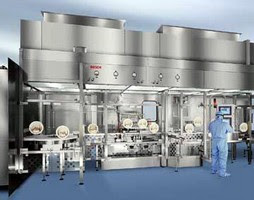
Restricted Access Barrier Systems also can accept certain restrictions and offer increased operational flexibility. Most pharmacies choose RABS over Isolators because they are quicker in the changeover process. Like laminar flow hoods (LFHs), RABS feeds clean air from fan units through HEPA filters and air vents from the unit into the barrier system.

Air exits through small opening to the room at a low level. RABS provides separation by the barrier and positive airflow. RABS air handling is much simpler than the isolator because the isolator uses recycled and recirculated air. RABS usually are cleaned manually followed by a CIP unit to clean up commodities. This process is more simple than the cleaning process of an isolator, which includes bio-decontamination.

Environmental monitoring is necessary to ensure the ISO 5 environment in the system is working correctly. This monitoring is done by built-in sampling ports. In RABS, there is also an option to use a portable sampling device inserted at the floor level air exit opening. Restricted access barrier system RABS for aseptic manufacturing is a critical competent to any successful packaging operation.

Although there are so many pros, the regulatory issues must be considered as well. The RABS has a so called "open door" that could potentially compromise the a septic environment and could be very harmful. Appropriate measures should be taken to ensure that the aseptic environment is maintained and that you do not have a leak. SOPs may be required to maintain the environment.

When implementing a RABS, companies must remember the system part of this technology. To successfully implement a Restricted Access Barrier System, engineers and maintenance personnel must ensure that it is integrated into its surrounding environment and that proper maintenance is provided to the system. It must have the correct surrounding building and room design, including HVAC and air-handling systems.

Proper disposal systems for bio-decontamination must be present, as well as drainage systems. Building system utilities can impact the system pressure controls. Management oversight is also a very important factor when implementing a RABS device, the company should have at least one member of a maintenance personnel that is able to manage and repair the RABS. Continuous system managing is a must have.

RABS is a very successful and efficient system that is used in pharmaceutical, medical, chemical, and electrical engineering industries. RABS have proven to be more successful and convenient than the isolator. Open-door RABS are more likely to contaminate and release toxins into the air than closed-door RABS. With improved technology today, it is very unusual to see a sterile drug operation to be run without a barrier system such as a RABS.

Comments

Popular posts from this blog

Checklist for Audit in Sterile Area

Checklist for Audit in Sterile Area Checklist to verify the sterile manufacturing area before the audit. 1. Is there any SOP giving details for activity/ movement in the sterile area. 2. Verify the suitability of system for sanitization of hands. 3. Is there the SOP on entry-exit; gowning and de-gowning into the critical area available? 4. Verify the availability of following records:  Air pressure differential  Particulate monitoring  Temperature  Humidity  Microbiological monitoring by settle plate 5. Are these records available and maintained as per SOPs? 6. Check the above mentioned individual records. Are the entries within specifications mentioned in SOP/ MTPs. 7. Is the controlled copy of MTP pertaining to monitoring by settle plate available to plant person? 8. Are the location for settle plates identified and the chart/ layout available with plant? 9. Are the following areas monitored for parameters mentioned in step 4:  Air-lock to the critical ar...

Aseptic Filling Process (Media Fill) Validation Protocol in Sterile Pharmaceuticals

Aseptic Filling Process (Media Fill) Validation Protocol in Sterile Pharmaceuticals Validation of sterile manufacturing process by media fill validation test as per PICS guidelines for aseptic validation or aseptic process simulation. 1.0 OBJECTIVE 1.1 To define procedures for validating and maintaining the validation of all aseptic filling processes and qualification of the quality of the product by system/facility/equipment. 2.0 SCOPE 2.1 This procedure applies to all aseptically filled sterile products intended for human use. 3.0 RESPONSIBILITY 3.1 The Validation personnel coordinate the aseptic filling validation program and write the sterile media aseptic filling processes reports. 3.2 Manufacturing personnel the sterile media aseptic filling processes and performs the sterile media fills. 3.3 QA personnel perform the sampling and assist with the IPQA monitoring required for each sterile media fill. 3.4 QC personnel to perform the testing and assist with the monitoring required fo...

MSDS (Material Safety Data Sheet)

MSDS   What Is an MSDS? An MSDS (Material Safety Data Sheet) is a document that provides detailed information about a chemical substance, including its hazards, safe handling procedures, storage requirements, and emergency measures. Today, MSDS is more commonly called SDS (Safety Data Sheet) under the Globally Harmonized System (GHS). Why MSDS / SDS Is Important Protect workers and employees Ensure safe handling and storage of chemicals Prevent accidents and injuries Provide emergency response information Comply with workplace safety regulations.  MSDS (Material Safety Data Sheet)  International safety standards.  GHS – Globally Harmonized System Full form: Globally Harmonized System of Classification and Labelling of Chemicals Develop by United Nations (UN).  OSHA (USA) – Hazard Communication Standard (HCS) Factories Act & Chemical Rules (India) Factories Act, 1948 Manufacture, Storage and Import of Hazardous Chemical Rules, 1989 REACH (Europe) REACH Regula...

Steps for HPLC Method Development

Steps for HPLC Method Development Know about the different steps of the HPLC analytical method development in pharmaceutical analysis. Analytical method development is considered as a critical process in pharmaceuticals. Availability of the different types of columns, operating  parameters, mobile phase composition, diluent and pH values make it critical to develop an analytical method. A good analytical method should be  simple, used column, mobile phase and buffer should be common. It can be done easily step by step. Following are the common HPLC method development steps. 1. Selection of HPLC Analytical Method 2. Selection of Chromatographic Conditions 3. Parameter Optimization 1. Selection of HPLC Analytical Method: First of all consult the literature that is available on the product. It will help you to understand the nature of  the product that will help to select the different parameters. A. Sample Preparation: Select method to prepare the sample according to its ...

Blow Fill Seal (BFS) and Form Fill Seal (FFS) Technology in Sterile Manufacturing

Blow Fill Seal (BFS) and Form Fill Seal (FFS) Technology in Sterile Manufacturing Know about sterile pharmaceutical production using Blow Fill Seal (BFS) and Form Fill Seal (FFS) technology. Both of these techniques are used to manufacture  sterile pharmaceutical products   as parenteral (LVP & SVP), infusions, ophthalmic and inhalation products. These are automated techniques to prepare sterile products. The basic concept of the  FFS   and BFS is to reduce the  contamination   by forming the container, filling and sealing in a closed sterile chamber of the machine. There is no personnel intervention to reduce the chances of the contamination during the manufacturing of sterile products. It gives more production at very low operational cost with the high assurance of  sterility . Blow fill seal technology is widely used and accepted by the various pharmaceutical regulatory authorities as US-FDA and MHRA. The system is being used for over 30 years a...